All Categories
Featured
Table of Contents
When considering enhancing customer experiences, Pasquale DeMaio, VP of Amazon Link, says to embrace systems that utilize AI and human strengths. "In client support, agentic AI will manage routine demands while human representatives will attend to intricate concerns with compassion and subtlety, directed by AI insights and recommendations." CIOs need to acknowledge a paradigm shift in UX, as data entry forms, customer journeys, and authoritative reports get changed with agentic AI abilities.
"AI agents will end up being the frontend of the business as the main starting point for any and all external contact," says Antoine Nasr, head of AI at Planning. "End-users will no longer have to try and navigate to the proper department and tool to get the assistance or details they require they will just communicate with the company's public AI representative in natural language.
Abilities spaces in crucial locations like AI, artificial intelligence and cybersecurity now impact almost 9 in 10 companies, affecting not just IT but every function across the business. Digital tools like AI, low-code/no-code platforms and advanced analytics have ended up being ingrained in everyday workflows, and all staff members must be equipped with the ideal abilities to drive efficiency and development.
Modernizing Your IT Infrastructure for the 2026 Shift
Dealing with these extensive skills spaces requires ingenious, organization-wide talent strategiesenabling companies to obtain and cultivate the knowledge required to modernize their workforce and completely realize the benefits of digital improvement. The strategic deployment of digital innovations to improve and scale organization processes stays main to successful improvement efforts. Organizations are progressively concentrated on making info more accessiblenearly half are prioritizing digital tools that break down data silos and make it possible for smooth access throughout the enterprise.
Along with these efforts, 46% of organizations are actively upgrading standard operating procedures to integrate new digital technologies, guaranteeing that processes evolve in action with innovation. Nevertheless, only about a quarter are prioritizing change management techniques as part of their transformation program. This limited focus on change management raises concerns as it might leave companies susceptible to staff member resistance, misalignment and engagement difficulties that can weaken digital efforts.
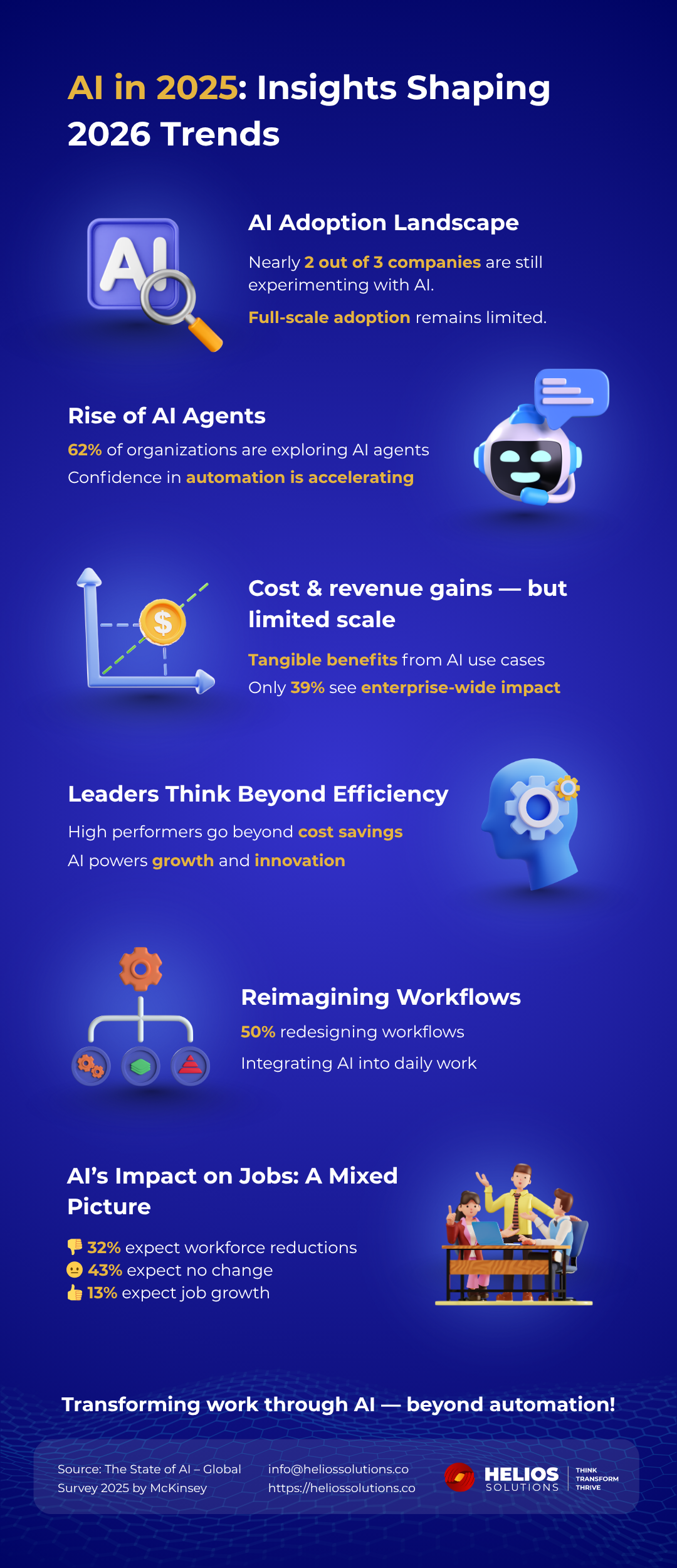
Comprehensive strategies, including senior management buy-in, clear interaction, targeted training and stakeholder engagement, are important for lining up teams with change objectives and promoting a culture of flexibility and constant improvement. In 2026, technology adoption continues to be a tactical driver of digital change, with organizations leveraging digital platforms to boost dexterity, scalability and innovation.
Ways to Create a Resilient AI Integration Roadmap
These innovations are not just widely implemented but also actively updated and refined by 17% to 18% of organizations, underscoring their main function in supporting seamless operations, hybrid work models and quick advancement cycles. Software application as a service (SaaS) and mobile internet technologies reveal strong adoption, incorporated by 42% and 39% of companies, respectively, throughout numerous company units.
With 17% of organizations presently running pilots and 37% reporting adoption at scale, generative AI (Gen AI) sticks out as the most actively piloted innovation in 2026. This signifies a shift from experimentation to operationalization as organizations seek to harness Gen AI for content production, consumer engagement and automation of intricate tasks.
Other innovations, such as huge information analytics (33% enterprise-wide adoption), automation innovations (31%) and basic AI (32%) are gaining traction, supporting sophisticated analytics, process automation and data-driven decision-making. While interest in emerging technologies is growing, adoption stays measuredparticularly for augmented/virtual truth and blockchain, where 34% to 41% of companies report no plans for implementation.
Not every organization discovers instant worth in adopting them since their relevance and impact can vary significantly depending on sector needs and company models. For lots of, the choice to invest is driven by targeted opportunities rather than broad applicability, resulting in a more selective method to innovation.
Does Your Cloud Technique Represent Australian Personal Privacy Laws?Whether enhancing client experience or updating facilities, the ideal roadmap varies by company and industry. From logistics automation to virtual healthcare, improvement can drive both development and performance.
In this article, we'll check out how services are accepting digital transformation, where initiatives are focused, and why it stays a leading concern for organizations looking for to remain competitive in a significantly hectic, tech-driven world. Digital improvement includes using the current digital technologies to basically improve how a business operates. While digital transformation ended up being a mainstream business important in the 2010s, the roots go even more back, starting with digitization in the 1980s and '90s.

Latest Posts
Essential Steps to Realizing Total Digital Transformation
Modernizing Your Enterprise for the 2026 Evolution
A Complete Guide for 2026 Success